Saturday, October 17, 2009

The osage tree

Osage trees grow in gnarly, twisting style. They have many branches and intimidating thorns. These qualities made them uniquely qualified as windbreak hedges on plains farms and as fences to keep cattle in place. Osage trees planted in a row produced a nearly impenetrable fence, sort of like natural barbed wire and chain link. The tree did not rust and was self maintaining.

Osage trees produce an inedible orange sized fruit in late summer and fall. They are called osage oranges or hedge apples. Squirrels like to pick them apart for the seeds and thereby reproducing the trees.


A part of Bittersweet Woods was a farm 50 years ago. There are several groups of osage trees in the woods which no doubt served as cattle fences. One incredible group of three large trees behind the house continue to grow despite being uprooted decades ago. The osage trees grow despite laying on the ground. Every year they project new large thorny branches up in the air, waiting to snatch our caps and snag our clothes as we mow the yard. The osage oranges begin dropping in August. Dozens of them roll down the hill into the back yard. Gabbie and Tess love to play with the oranges.


What amazes me is the hardiness of these trees. They grow no matter what. The wood is excellent firewood, burning slow and white hot, almost like coal. Osage wood is a bright yellow color. Cutting the wood produces bright yellow sawdust, cascading like gold dust over the ground and boots. The grain is so tough that it causes the cutting chain on a chainsaw to rub against the bar, generating occasional sparks.

I'd love to have more of this firewood. But the tree is so hardy, there are few opportunities to find dead or downed wood.

Osage is one of the unexpected curiosities that we discovered when we moved to Bittersweet Woods. It is with us all the time; I admire the tree for its hardiness. And every time we see an osage orange, it reminds us fondly of every dog we have owned since living here. They love to play with the oranges.

Wednesday, October 14, 2009

Change of seasons

The nice thing about living in the midwest is seeing the change of seasons. At least that is the response that we invoke when apologizing for the crummy cold, damp, gray portions of winter.

We are doing that change of season thing now, in October. Leaves are starting to drop. Firewood is piled up to record heights, thanks to 4 large tree blowdowns earlier in the summer. We've already enjoyed fires in the fireplace (that is the preferred location for fires). My favorite woods are locust and osage wood. They burn like coal - slowly with white hot coals and a low flame.

Soon most of the wildlife will be gone, or at least less obvious. Butterflies, birds, snakes, cicadas, crickets, hummingbirds, praying mantises (is that really the plural of mantis?, tree frogs, and other critters will vacate until spring. It will be quiet, except for the trickling stream, semi trucks on the interstate, and occasional winds whipping through the pine trees. Meanwhile, we'll recall our friendly (mostly) warm weather visitors with a few photos from this past summer. And look forward to seeing them again soon.


Click to enlarge and notice the spikes on the hind legs of this katydid - the spikes that produce the signature chirping/clicking sound.

But late fall and winter can be beautiful in its own way. Bright oranges, reds, and violet tones will blossom, then fade. Grays and browns will settle in. Evergreens stand out in their green or blue uniforms. Gabbie and Tess's white coats will be accented against the drab woods as they dart after deer.

It reminds me of the Mamas and Papas song California Dreamin, “all the leaves are brown,....and the sky is gray." Instead of California dreaming, we'll be dreaming of spring and summer which will come soon enough to Bittersweet Woods.

Saturday, September 26, 2009

Kids in the woods

Our grandkids have enjoyed Bittersweet Woods for many years. Connor was the first to notice elevation differences as a two year old. He clambored up the hill behind the house and announced "I'm way up high." He had not experienced a "high" at his one story home in the flatlands of western Ohio. Everything was on the same level.

Later, he took to splitting wood with a lighter weight axe. "That axe is sweet", he announced after taking a few swings as a 5 year old. Thereafter it has been referred to as the sweet axe. I saw it today as we put away tools in the shed as the rain started falling. He ran several toy chain saws and lawn mowers into the ground "helping" the grown-ups with that important work.

Catrina, the youngest, couldn't he kept from the trail. She demanded, as only a two year old can, to accompany us on dog walks down the trail. She toddled bravely, usually shunning Pap's offered helping hand. By the end of the week, she was negotiating hills, rocks, and roots with confidence.

Their summer visit is an annual event. Here are pix from this year's visit. Bittersweet Woods brings out carefree fun and goofiness - for the adults, dogs, and kids. These are the precious moments, to use a spoofy line from the Trains, Planes, and Automobiles comedy movie, in a serious tone. We remember these times wistfully, knowing that the young'ns will grow older so quickly. But they'll have the memories their whole life.


Monday, September 21, 2009

Paw Paw


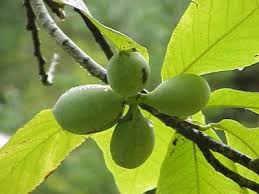
I ate my first paw paw of the season today. It's the latest this has ever occurred that I can remember. They are usually ripening by early September and are often gone by this late in September.

Paw paw has an appalachian ring to it, conjuring up an image of a dog extremity or ma's husband. A paw paw is a potato-sized wild fruit which grows on 10-20 foot tall trees in the deep woods throughout the midwest and south. They have never caught on as a mainstream fruit. It has unusual flavor (an acquired taste), is soft and bruises easily, and has many large seeds in the fruit.


Paw paws do have a cult following in some areas. There is the Paw Paw Festival in Ohio and The Ohio Paw Paw Growers Association. Paw Paws have been linked to some medicinal uses - from a laxative in the late 1800's to controlling cellular growth in cancer tumors in the late 20th century. The latter has fascinated me because there appeared to be legimitate research supporting this claim. But I've heard little about it beyond limited paw paw enthusiasts' discussion. 

Dad has had a liking for paw paws for many years. He was amazed when we moved the Bittersweet Woods to see how many paw paw trees we have on our few acres of forest land. I assumed that he went into the woods as a kid to find paw paws. But he said that his father knew about a single tree outside of town. They used to stop there each fall when the paw paws ripened. This week has been tough for him with various ailments that 88 year-olds often face. He was frazzled when I stopped the other day; but his face broke into a wide smile when I placed a large ripe paw paw in his hand.

Friday, September 4, 2009

The Cicada

It's early September in Bittersweet Woods. Bright sunny days, cool nights. Perfect weather for these often humid, hazy, or cloudy latitudes. The signature sound for late summer here is the buzzing of the annual cicada. These are the dudes which appear each year in mid-summer. They flit around in trees and issue forth with loud buzzing sounds.

For their size, they are one of the noisiest animals in nature. The sound is the male mating call produced by vibrating sections of their abdomens. Starting at mid-day, you can hear them everywhere there are trees. There are several sounds. One is a torpid, slow buzz that starts slow then tapers off. It's as though they are just waking up or warming up. Then there is the familiar loud droning sound, continuous modulating buzzing sound. Last there is an in-between sound, more subdued, less strident. You can catch some of the variations in these videos.


I really like the plaintive background noise of cicada calls. It brings back memories of childhood - of trying to catch the cicadas and seeing the empty larval shells from which the cicadas emerge. It is also a bittersweet summer sound - a sweet comforting reminder of this beautiful time of year but a bitter (sort of) sign that summer is inevitably waning.

I hear the cicadas everywhere there are trees, even in urbanized areas. During Edward Kennedy's burial procession to Arlington National Cemetery, cameras showed the motorcade slowly coming into view at dusk. The reporters quieted. In the background was an unmistakable cicada chorus. Tonight a reporter on the TV news spoke from the White House grounds. Cicadas nearly drowned out the the reporter's impassioned explanation of something thought to be important.

What chorus of life - people, nature, pets - do you hear in your corner of the Woods. Are you listening?